Home / Who we serve / Law enforcement
Law enforcement · GIT and ASOC
Detection finds the drone. Your officers have to reach the pilot.
Train your Ground Intercept Teams and ASOC crews together, practice the response in Promachos between courses, and test your procedures before an actual drone incursion.
Use cases
The calls your agency will get.
Stadium and event day
A drone inside the TFR during a game. The ASOC confirms the track, dispatches the closest GIT and keeps the federal partners informed while the team works the contact.
Drone over a crowd
No Remote ID, no home point. The air team gets eyes on it, the ground team searches, and every decision is logged for the report.
Corrections facility
A drone over the yard after dark. Find the operator before the drop, make a lawful contact and preserve the evidence.
Airport approach
A drone near a runway end. Coordinate with airport operations and air traffic stakeholders while your officers locate the pilot.
Critical infrastructure
Repeated flights over a substation or plant. Decide when it is a nuisance, a pattern or a threat, and who acts.
The paperwork
Warnings, credible-threat calls, confiscation or referral, and federal reporting on time, with the 180-day data limit met.
Practice between courses
Your teams work the call in Promachos.
Dispatchers, ASOC operators, Ground Intercept Teams and Drone Air Teams each take their own seat on one incident over your own jurisdiction. Field teams use their own phones: assignment card, directions, status taps, photos and chat with the ops center.
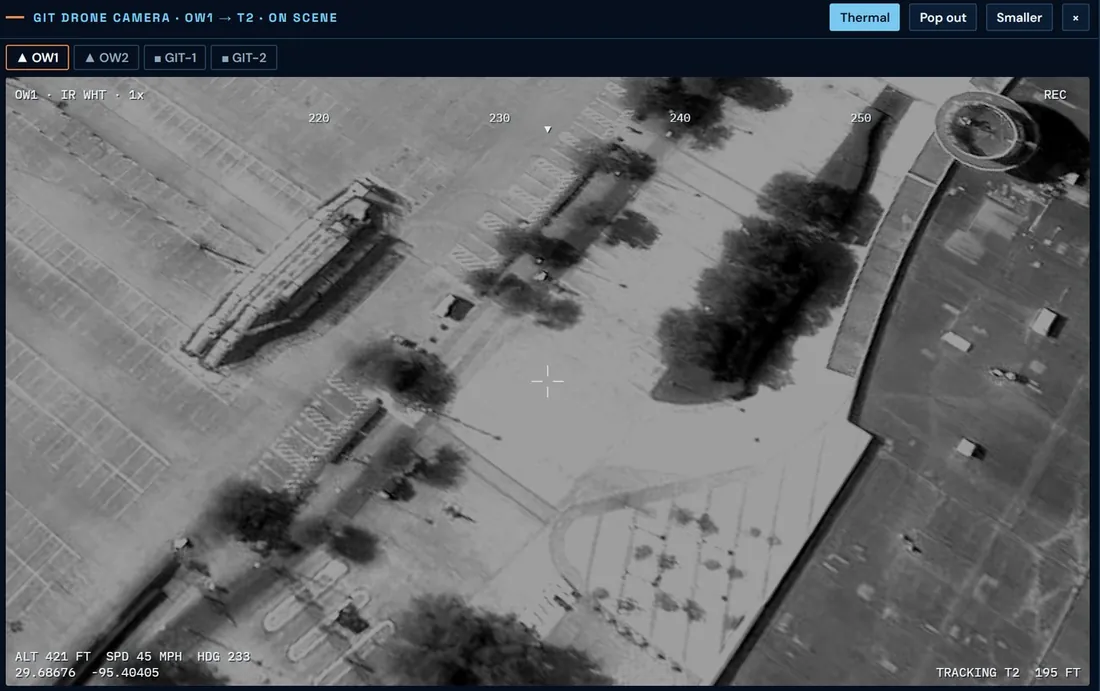
Simulated DAT drone camera over real imagery of the exercise area.
The program
Train, practice and test as one cycle.
Train
The three-day GIT + ASOC course: a joint day, split tracks and a field exercise on the equipment you deploy.
Practice
Promachos keeps every seat sharp between courses, with no equipment and nothing transmitting.
Test
Evaluated exercises run against your own SOPs and end with a written after-action report.
FAQ
Questions we hear.
Our sensors are already deployed. Why do we need this?
Sensors find the drone. Your officers still have to reach the pilot, make a lawful contact and document it so it holds up. That hand-off between the ops center and the street is where most responses fall apart, and it is what this program trains.
Does this teach our officers to operate mitigation systems?
No. Certified agency personnel operate 6 U.S.C. § 124n systems, and your vendor trains your operators on each system. We train the response around them: detection, triage, dispatch, contact and documentation under Part 124 and the DOJ/DHS model policy.
Can dispatch and patrol train without everyone in one room?
Yes. In Promachos the instructor hosts the exercise and trainees join with a code from their own screens. Field teams work from a web link on their own phones.
Does it cover corrections facilities?
Yes. Drones over jails and prisons are the same problem: detect, find the operator, make contact and document. We build the scenario around your facility.
How does this relate to FBI NCUTC certification?
It supplements it. NCUTC certifies operators; this program trains the ground and ops-center response your policy requires.
Contact
Get your officers ready for the next drone call.
Tell us your agency, the venues or facilities you cover and how many officers would train.
Prefer email? justin@cagairspace.com